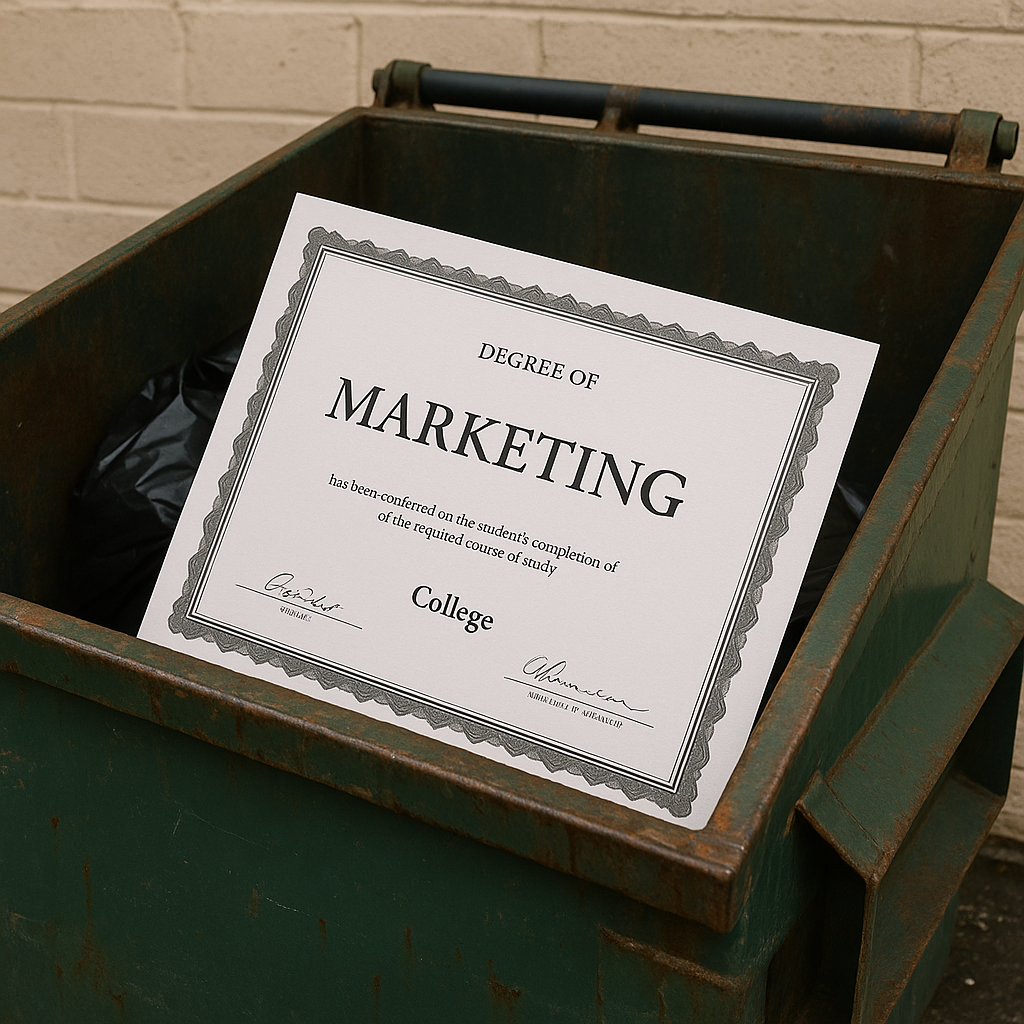
I’m one semester away from graduating from college. And I’ve come to conclude (based on my experience and the experiences of many others) that getting a college degree is NOT worth it if you want a career in marketing.
Here are 5 reasons why that’s the case:
What You Learn Gets Outdated Fast

There will always be a disconnect between the knowledge you get from college and the knowledge that’s relevant in the marketing field – in the real world.
Marketing is a fast-moving, constantly updating field. And what works today may not necessarily work a few months from now, or even a few weeks from now. This is especially true for digital and social media marketing.
So with the exception of basic concepts like AIDA, the knowledge you gain from marketing courses will likely have become obsolete by the time you graduate.
Employers Don’t Care

Marketing is increasingly becoming digital. And in this digital world, most employers and clients don’t care whether or not you have a bachelor’s degree. They just want to know if you can meet and surpass their KPIs.
Can you produce more leads, higher CTR, more sales? Can you drive up engagement on social media? That’s what matters. If you can prove this to employers through internships and personal projects (more on this later), then you’ll get hired on the spot!
Some employers put a Bachelor degree as a requirement in their job listings because it helps them sift through resumes easily. It’s not out of a sincere conviction that college graduates are better equipped to handle a marketing job than non-college graduates.
There is a Surplus of Marketing Degrees

Marketing is an easy major. It’s also not the worst subject you can pick in terms of ROI. I’m not saying it’s the best, or even among the best. But it’s not the worst.
So as a result, a lot of people are going to major in marketing. That means there’s a large pool of marketing graduates for employers to choose from.So a marketing degree won’t help you stand out as much unless you have a Masters or a PHD.
If you want to go that route, consider the cost of student loan debt, which I’ll talk about more in depth later.
In the old days, only a small minority of the population went to college. And you were almost guaranteed a cushy job once you got your degree regardless of your major.
But in today’s world, that’s not the case. Everyone and their grandma has a college degree. And you’ll have to bring more qualifications to the table in order to stand out.
Lots of Fluff

I understand you shouldn’t only take marketing-related classes. It’s important to get a well-rounded education that consists of various subjects; from liberal arts to natural sciences.
But in the name of “well-rounded education”, many colleges and universities require you to take many “fluff” courses – courses like Ethnic Studies and Business Information Systems with applications These types of courses offer little or no value to students and are largely a waste of time.
Fluff courses are one of the many ways that universities cynically extract as much profit as they can from each student. These institutions often suffer from administrative bloat and require ever-increasing funds to support their expanding faculty and staff.
In other words, they don’t require you to take these courses because they care about you getting a well-rounded education.
There are Far Better Alternatives for Building Connections

In the old days, one of the reasons people went to college is to build professional connections. But in today’s world, there are far better alternatives.
You can find pretty much every marketing professional on LinkedIn and other networking platforms. You can reach out to these people on social media. Or you can visit their website and contact them there.
Even if the university you’re going to is one of the best marketing schools in your state and many of its alumni went on to become successful marketers, it’s still better to connect with these people online. The latter approach doesn’t cost you anything and is just as effective in getting people interested in working with you.
So building connections isn’t worth burdening yourself with nasty student loan debt and wasting your precious time with useless courses.
Do This Instead
If I could go back to my first day in college, I’d drop out. I would start a website and I’d start putting out content, be it blogs or videos. I’d also create products to sell (such as design merch). Because selling is the end result of marketing.

I’d recommend you do the same instead of going to college. If creating your own website is too expensive for you, then create content on social media or other publishing platforms – such as YouTube, Instagram, TikTok, and medium.
And consider getting an internship. A good internship can help you build valuable skills and generate hands-on work experience that employers are looking for. Ideally, you should do both internships and personal projects.

Doing this is a far better route for making yourself attractive to employers than going to college. You don’t need to burden yourself with insurmountable debt and waste your precious time taking useless courses. Working in the real world will make you far more competitive in the marketplace than theorizing in the classroom.
You might ask, “What if I attend college AND do internships and side projects? Doesn’t that improve my career prospects?”
There is some truth to this idea. It’s smart not to put all your eggs in one basket. But you have to consider the cost of college education, not just in financial terms, but in terms of time.
If you’re the average person in America, chances are you won’t be able to pay for college out of pocket – You’ll likely need to take out student loans. The average student loan debt for Marketing majors is between $25,000 and $32,000. And You likely won’t be able to pay it back for at least 10 years.

Does it doesn’t make sense to pay that much money for knowledge that’s available for free or for much cheaper on the internet?Does it doesn’t make sense to pay that much money for knowledge that’s available for free or for much cheaper on the internet?
And the time you spend learning basic and soon-to-be-outdated information in college is the time you can invest acquiring up-to-date knowledge and hands-on experience in the real world. Remember, time is more valuable than money because you can’t get more of it.
“Then Why Don’t You Drop Out of College?”
You might say, “then why don’t you drop out of college if you’re so against it?”
Well, I would’ve dropped out if I was a freshman or a sophomore. But I’m in my last semester of my senior year – I’m way too deep into this. So I might as well finish it and get the damn piece of paper.
Sure, a college degree doesn’t differentiate you as it used to. But it can still open a few doors for you when you look for a job than if you didn’t have a degree. Many HR people are lazy. They put a bachelor degree as a requirement to make it easier for them to sift through resumes.
So having a bachelors may land you a few more first interviews. But beyond that, it doesn’t help that much. It only serves for bragging rights.
Another reason why I’m finishing up college is because I’m paying my tuition out of pocket. So I won’t have any student loan payments once I graduate.
But I’m not finishing college because I believe it has a good ROI overall. Again, I would drop out if I could go back to day 1. But since I’m so close to the finish line, let’s just be done with it.
It’s like how Glen Powell trained to be a jet pilot for his role in the movie Top Gun Maverick.

Once Powell finished with the filming, he decided to finish up his pilot training and get a license even though he was done with the movie and he’s no longer required to operate fighter jets. He’s already completed most of the training so it makes more sense to reach the finish line. I have the same mindset when it comes to college.

Conclusion
Taking these 5 factors into perspective, I would say that going to college for marketing is not worth it. If, after considering the points above, you still choose to pursue a marketing degree, that’s your decision and I respect it. My goal with this article is to simply help you make a more informed choice regardless of what you decide.
Hope this helps!